
The Industrial Design of Final Fantasy VII Remake
Affiliate Disclosure: This article may contain affiliate links. If you purchase through these links, Airship Deluxe may earn a small commission at no additional cost to you.
In Final Fantasy VII Remake, a modern reimagining of the 1997 role playing game, the environment tells its story before the player does anything at all. Long before combat systems, dialogue, or play objectives, the city of Midgar establishes mood, power, and conflict through architecture, scale, and light. The game’s environmental design is the primary vehicle at delivering the narrative.
Midgar is a vast industrial city built around the extraction of mako energy, controlled by the Shinra Electric Power Company. Mako is the planet’s extracted life energy, processed by Shinra to power Midgar. Shinra presents itself as a provider of progress and stability, but its influence is embedded directly into the city’s structure. Power is expressed spatially. Class is reinforced architecturally. Control is made visible through infrastructure rather than exposition.
This article examines how Midgar’s design communicates those ideas through materials, lighting, and spatial hierarchy. By reading the city as a constructed system rather than a backdrop, we can better understand how industrial sci-fi environments convey authority, inequality, and control, and how those principles translate into real world design without slipping into imitation or cosplay.
Images of game environment are captured in-game and lightly edited for clarity. Use the links below to jump to specific sections:
Midgar as a Designed Machine
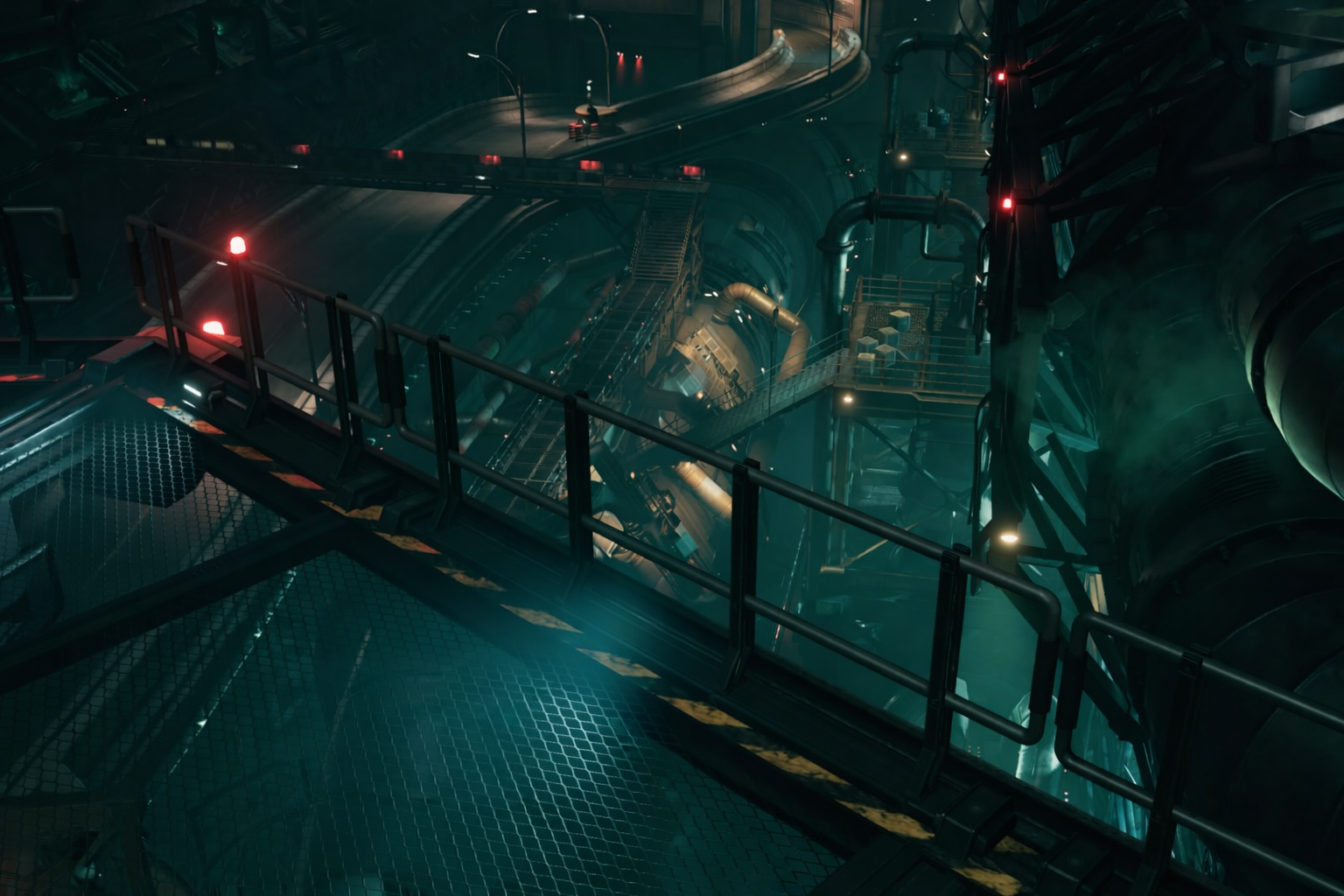
In Final Fantasy VII Remake, Midgar is not a careless or purely symbolic environment. Many of its systems are designed to feel functional and lived in. Ventilation fans beneath the plate, artificial sun lamps, and the residential architecture of the upper plate all reinforce a sense of plausibility. The city works hard to appear operable, even when no real world analogue exists.
At the same time, Midgar is not optimized for efficiency or human comfort across the board. Movement between sectors is deliberately constrained by gates and partitions. Infrastructure is frequently oversized, indirect, or redundant. These choices introduce friction rather than flow. In some cases, believability is clearly sacrificed for gameplay, such as oversized sewers or simplified power reactor controls. In others, excess and obstruction appear intentional, serving authority rather than utility as a deliberate design choice. Comfort is distributed unevenly. Efficiency is secondary to visibility, segmentation, and control. Midgar feels coherent because every system reinforces who holds power and who does not.
© 1997, 2020 SQUARE ENIX CO., LTD. All Rights Reserved.
Viewed this way, Midgar operates as a designed machine of authority. Some components support daily life. Others restrict movement and access. Together, they create an environment where control, spectacle, and scale matter more than balance or restraint. This framework allows the city to feel simultaneously believable and oppressive, and it sets the foundation for every design choice that follows.
Vertical Power
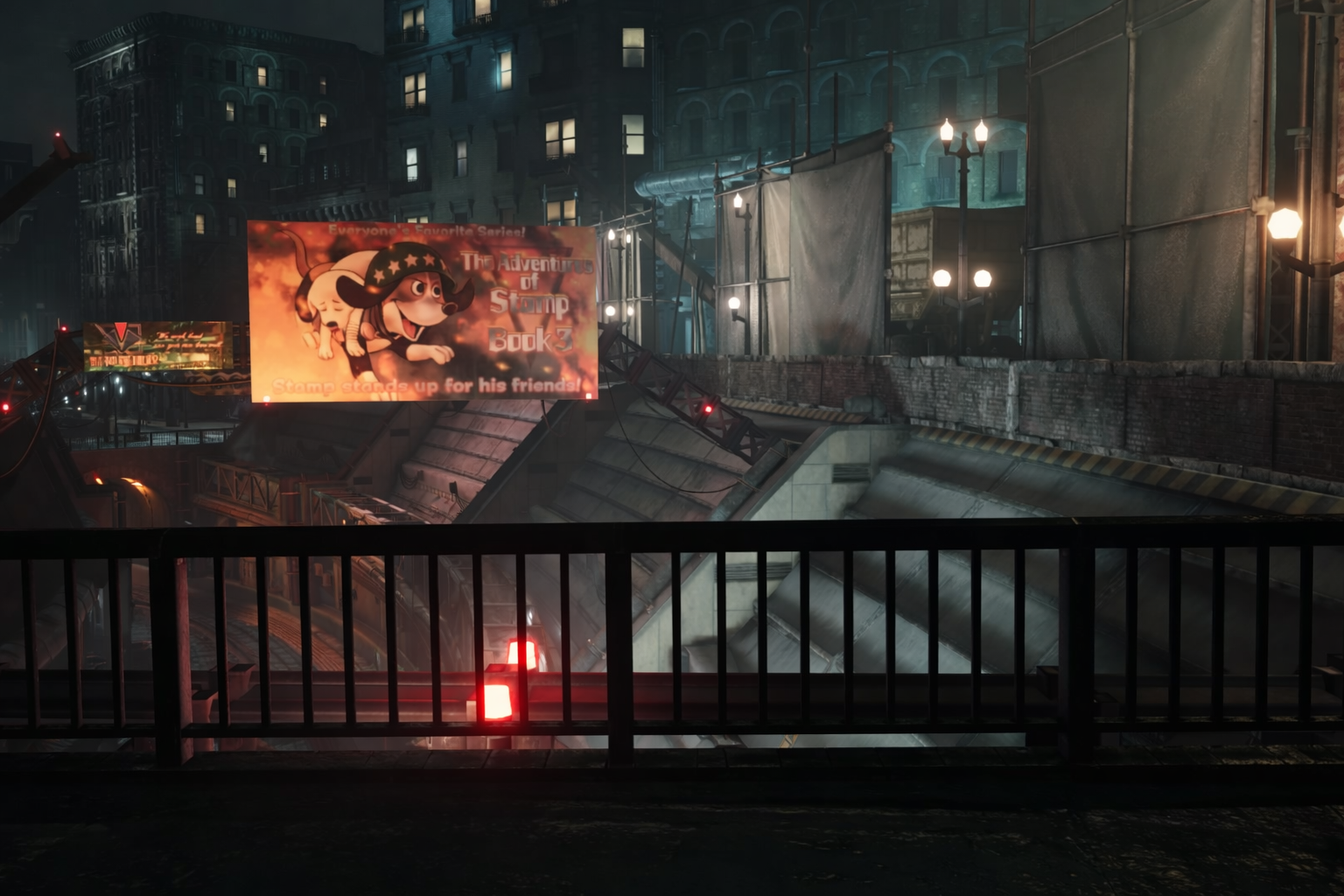
In Final Fantasy VII Remake, power is organized vertically before it is ever explained narratively. Midgar’s most important division is spatial. Authority occupies the upper plate. Labor and the visible costs of Shinra’s system are pushed below the plate. Height becomes a physical expression of hierarchy.
Life on the upper plate appears functional. Open exposure to the sky and natural sunlight reinforces a sense of normalcy and Shinra’s claim that progress is clean and stable. Surfaces are finished, infrastructure is cleanly integrated, and residential areas feel orderly, not because they are humane, but because disruption is displaced elsewhere. Distance from the slums below functions as a buffer. Elevation reduces contact with pollution, extraction, and scarcity.
© 1997, 2020 SQUARE ENIX CO., LTD. All Rights Reserved.
Below the plate, the design language shifts. Light becomes artificial and uneven. Systems are exposed, including makeshift electrical routing and overhead mechanical structures. Materials are mixed, repaired, and repurposed. Space is more dense and improvisational. This is not simply decay. It is enforced proximity to infrastructure and consequence. The slums are not beneath the plate by accident. They are positioned to absorb the costs of what happens above.
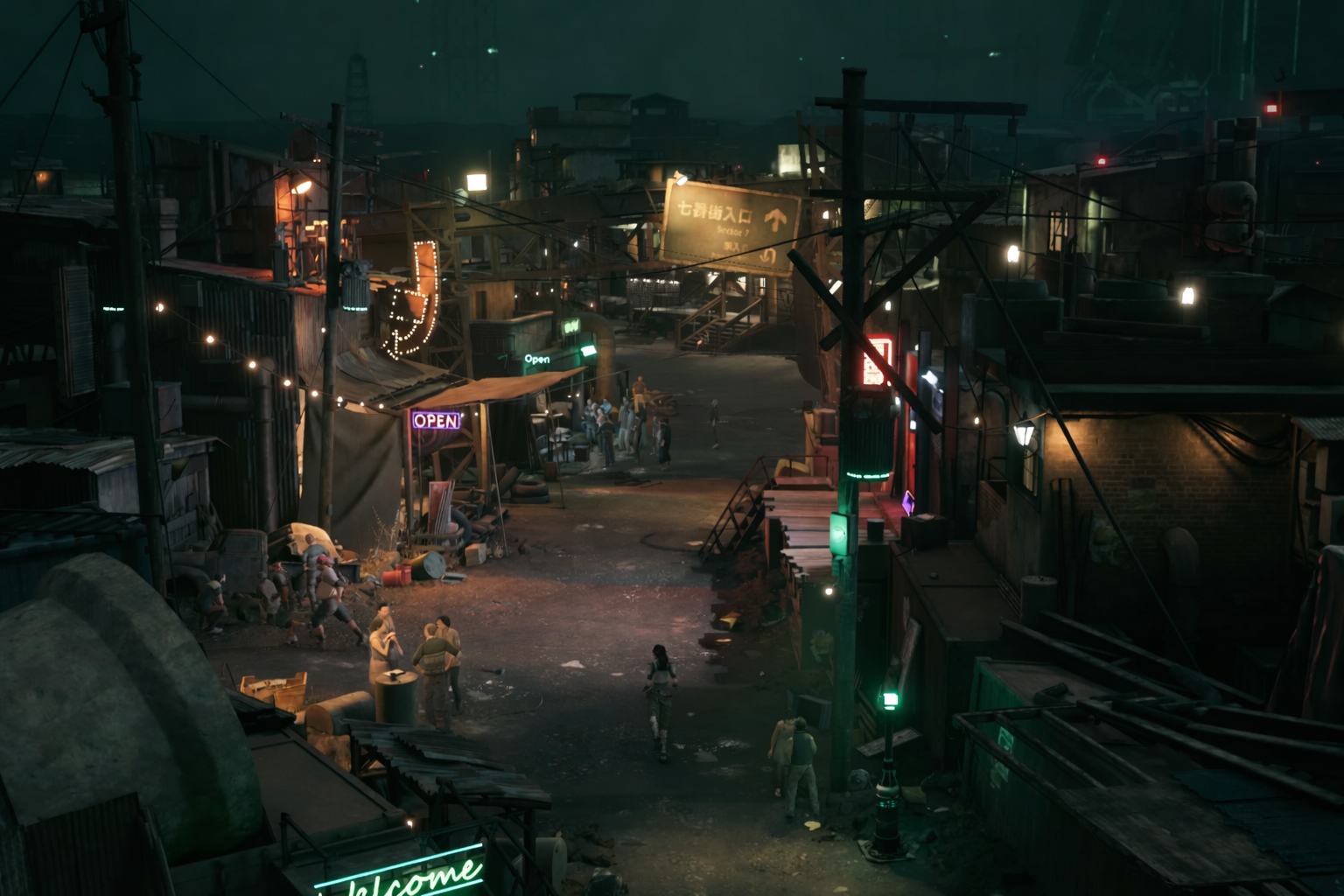
© 1997, 2020 SQUARE ENIX CO., LTD. All Rights Reserved.
What makes this vertical arrangement effective is its consistency. Movement between layers is restricted, monitored, and deliberate. Even the trains that provide access between the upper and lower plates are strictly surveiled, with protective measures on standby. Gates, elevators, and checkpoints reinforce that elevation is granted or denied. Spatial hierarchy replaces dialogue. The city teaches the player who holds power by where that power is allowed to exist.
Materials That Signal Control
In Final Fantasy VII Remake, materials are chosen to communicate permanence, authority, and compliance. Steel, concrete, and glass dominate Midgar’s built environment because they read as immovable, engineered, and institutional.
Steel appears repeatedly in structural frames, walkways, railings, and machinery. It signals durability and enforcement rather than craft. In spaces directly designed and maintained by Shinra, surfaces tend to be smooth, uniform, and standardized, reinforcing institutional order rather than individual presence. This consistency discourages personal adaptation and emphasizes that the city is governed by systems, not people.
Concrete amplifies this effect through mass and weight. Walls feel thick and unyielding. Spaces are defined by load bearing forms rather than decorative partitions. Concrete is rarely softened. It exists to separate, support, and contain. In Midgar, it communicates that structures are intended to outlast the people moving through them.
Glass plays a different role. In Shinra dominated areas, it creates transparency without vulnerability. Offices and corridors allow visibility while maintaining separation. Glass here does not invite openness. It enables oversight. In Shinra’s highest offices, glass is used to extend authority outward rather than inward. Elevated windows frame the city as something to be surveyed and dominated, reinforcing power through visibility without exposure.
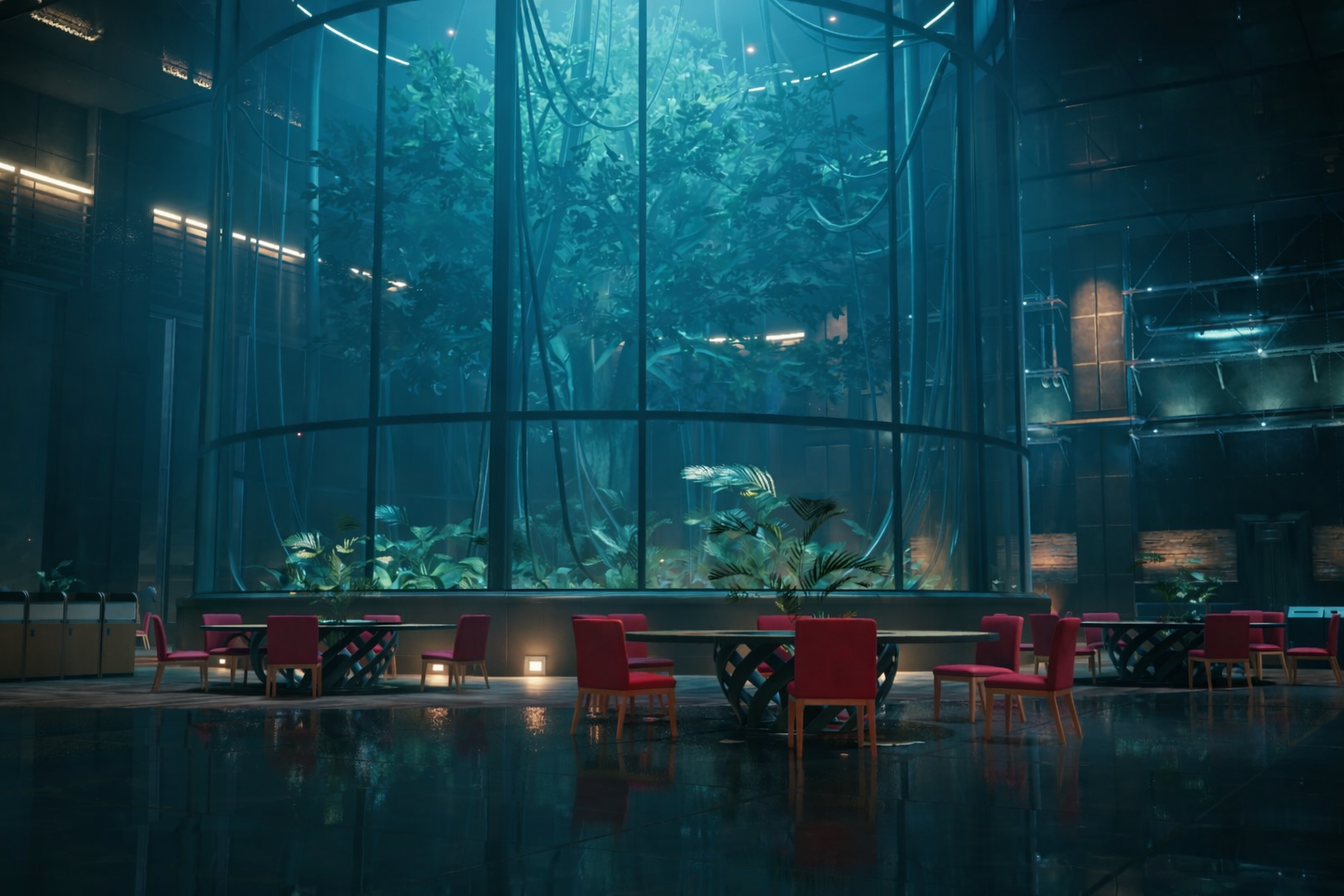
© 1997, 2020 SQUARE ENIX CO., LTD. All Rights Reserved.
In rare interior spaces, personal expression appears as an overlay rather than a foundation. Hand painted murals and improvised decoration introduce warmth and individuality into rooms otherwise defined by containment and control, highlighting how personality must be actively constructed within industrial systems that were never designed to support it.
Below the plate, these same materials take on different meanings. Steel is patched and repurposed. Concrete is stained and cracked. Glass is scarce or broken. Uniformity gives way to improvisation. The material palette stays industrial, but control over it is lost. Authority is expressed through access to refinement and maintenance, not through the materials themselves.
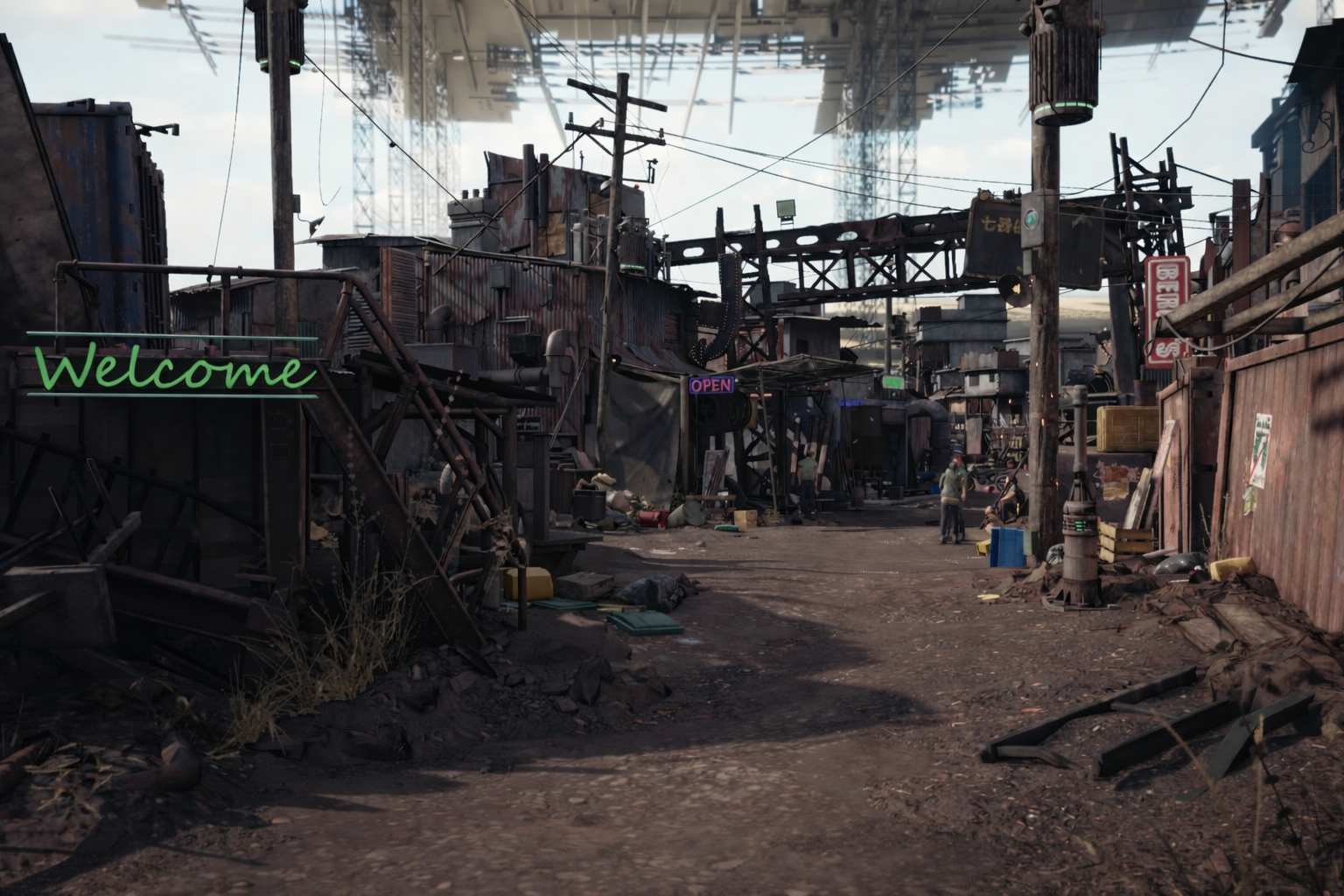
© 1997, 2020 SQUARE ENIX CO., LTD. All Rights Reserved.
What makes Midgar’s material language effective is this contrast. Control is not communicated by exotic substances or futuristic finishes, but by who gets clean surfaces, consistent construction, and stable systems, and who does not. Materials become a quiet but persistent indicator of where power resides.
Lighting as Emotional Authority
In Final Fantasy VII Remake, lighting operates as a managed system rather than a neutral condition. Its role is to define where stability, productivity, and civic normalcy are permitted to exist.
Above the plate, access to the open sky provides unmediated daylight. Natural light reinforces the impression that life at this elevation is autonomous and self sustaining. At night, artificial lighting is orderly and consistent, supporting the sense of a functioning, uninterrupted city.
Below the plate, light is present and functional, but it is mediated. Sun lamps replace the sky, supplying engineered daylight sufficient for daily life, commerce, and social activity. In some areas, limited natural light filters through gaps in the plate, creating brief moments of softness within an otherwise constructed environment. This filtered daylight can be read as a quiet metaphor for hope, present but constrained, never fully free. The distinction is not brightness, but dependency. Daytime below the plate exists because it is built, regulated, and maintained by Shinra rather than naturally available.
At night, illumination across the slums remains active and purposeful. Streets, walkways, and public spaces are lit well enough for movement and safety, while brighter concentrations form around businesses, interiors, and gathering spaces. Areas like Wall Market demonstrate that artificial lighting can support comfort, excess, and social energy, not just survival. The presence of visitors from the upper plate reinforces this point. These spaces are not hidden or forgotten. They are integrated into the city’s economic and social circulation, even as they remain structurally subordinate.
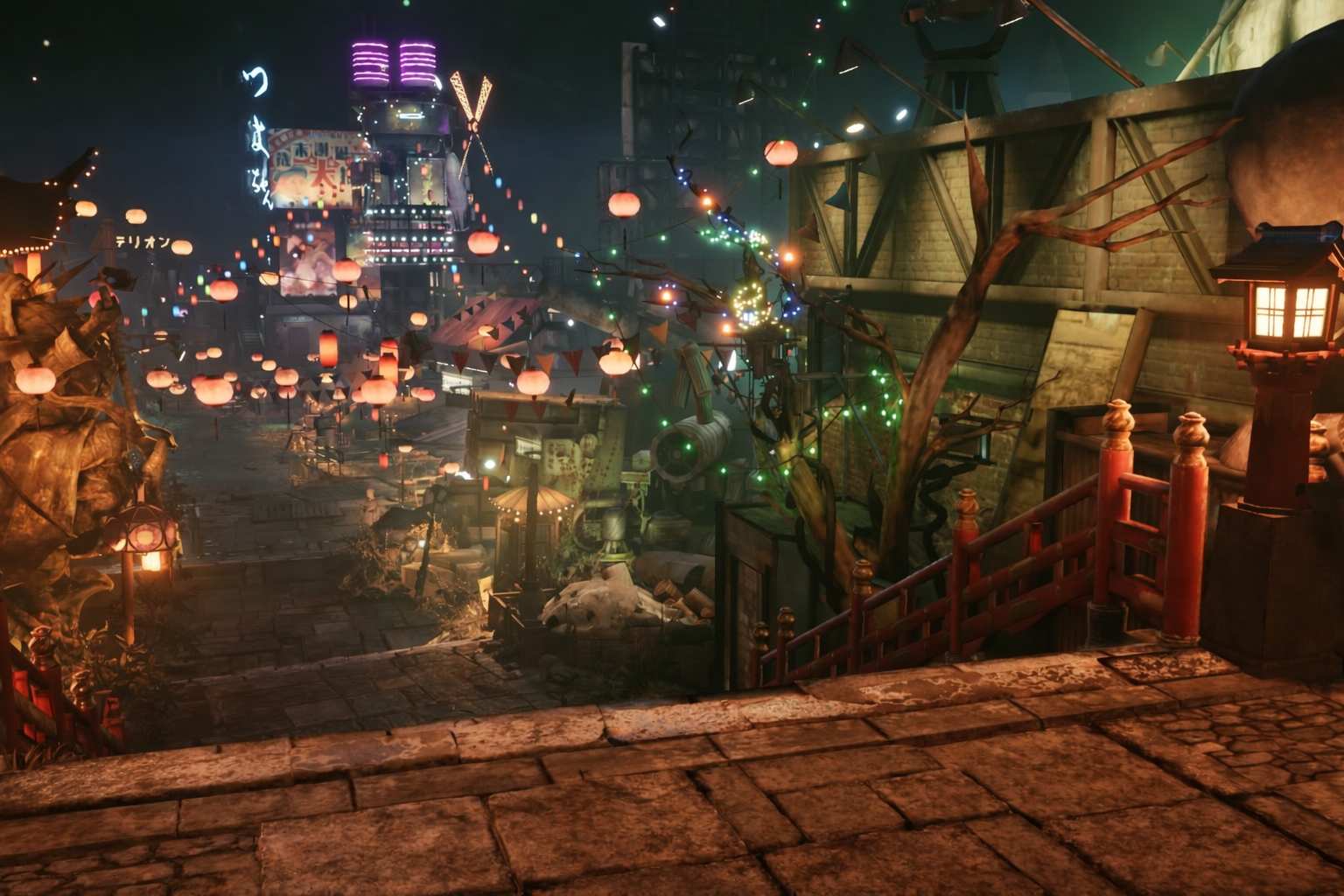
© 1997, 2020 SQUARE ENIX CO., LTD. All Rights Reserved.
Color sharpens this hierarchy. A pervasive green glow associated with mako energy recurs throughout Midgar, from reactors to upper plate structures and Shinra Headquarters. In Midgar, illumination is primarily organized around energy systems, infrastructure, and circulation rather than comfort or atmosphere. Much of the city’s ambient light does not come from fixtures at all, but from mako itself. It leaks, glows, and radiates through reactors, conduits, and industrial structures. Through repetition, this color becomes inseparable from extraction and institutional power. Unlike logos or signage, the mako gradient saturates the environment itself, embedding authority directly into the city’s atmosphere.
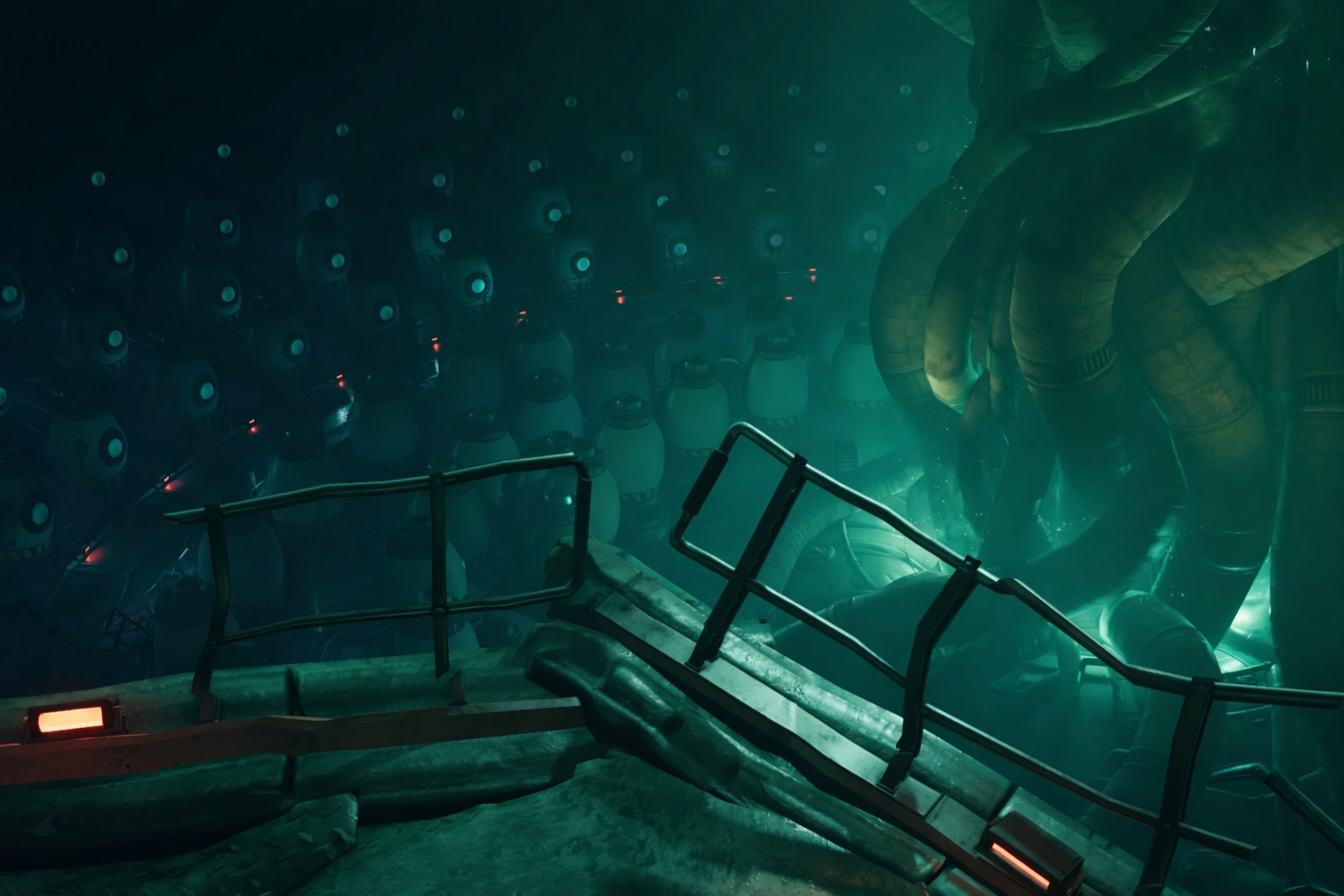
© 1997, 2020 SQUARE ENIX CO., LTD. All Rights Reserved.
In Midgar, lighting does more than illuminate space. It defines who controls the conditions of daily life. Normalcy below the plate is engineered, timed, and sustained by external systems. Visibility, like energy and space, is granted rather than assumed.
Scale, Silence, and Negative Space
In Final Fantasy VII Remake, scale communicates power through excess. Monumental spaces are designed to impress, intimidate, and overwhelm simultaneously. Size becomes a visual shorthand for authority, wealth, and institutional permanence.
This approach varies by context. Corporate and executive areas within Shinra Headquarters often use scale ornamentally. Grand lobbies, elevated offices, and exhibition-like spaces present power as refined and aspirational. These environments frame Shinra as stable, modern, and benevolent, offering comfort and spectacle that contrasts sharply with the rest of the city.
Laboratories, military facilities, and industrial complexes use scale differently. Here, large volumes exist to support large projects. Oversized chambers accommodate heavy machinery, complex experimentation, and coordinated deployment of personnel. These spaces are built to prioritize capability over intimacy. Big systems require big rooms, and human scale becomes secondary.
Shinra’s reliance on large scale mechanized security reinforces this logic. Facilities are designed to accommodate massive robotic units, heavy transport, and rapid force deployment, embedding intimidation directly into the architecture. Space is shaped around power expressed through machinery rather than people. Negative space strengthens this effect. Wide corridors, buffer zones, and expansive interiors regulate movement and visibility. These areas limit informal gathering, maintain surveillance, and prepare space for confrontation when required. Vast interiors mute individual presence. Sound dissipates. Figures feel small. The environment asserts control before any authority figure appears.
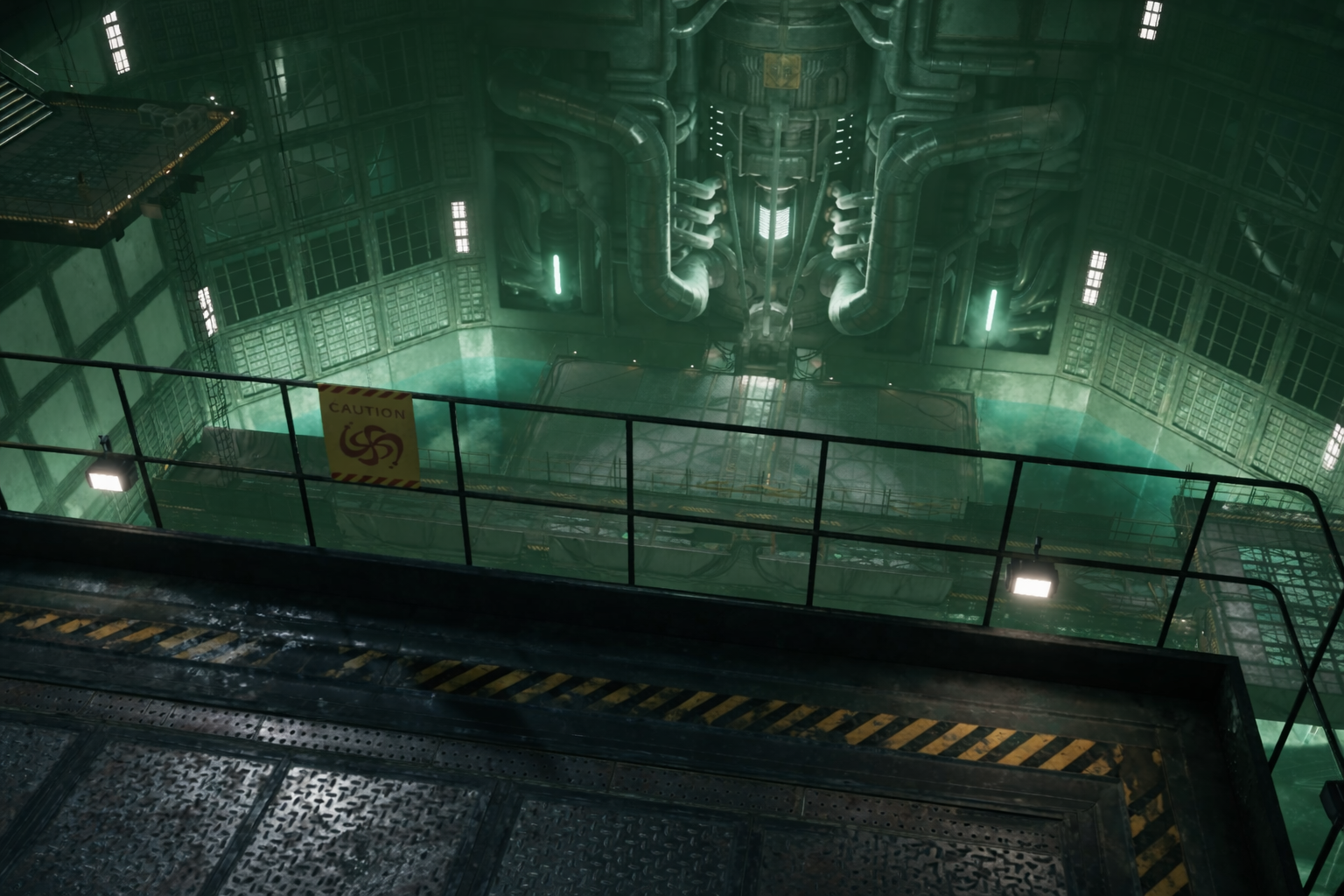
© 1997, 2020 SQUARE ENIX CO., LTD. All Rights Reserved.
Human scale returns primarily in residential and informal areas. Ordinary life is calibrated to the body, while institutional power operates at a scale meant to dominate it. Through excess space, controlled emptiness, and selective ornamentation, Midgar makes clear where power lives and how it expects to be encountered.
Translating Midgar into Real-World Design
Midgar’s design language works because its strongest signals operate at the level of structure and organization, not surface reference alone. Symbols, signage, mascots, and branding exist throughout Final Fantasy VII Remake, but they sit on top of deeper systems of material choice, lighting control, and spatial hierarchy. Translating this language into real world interiors, such as homes, studios, or workspaces, requires ensuring that requires ensuring that visual references and symbols never replace structure.
Restraint in Midgar does not mean cleanliness or minimalism. Many environments are cluttered with debris, equipment, and improvised objects. What is restrained is ornamentation. Decorative elements are rare. Visual complexity usually comes from use, wear, accumulation, and infrastructure rather than intentional embellishment. In practice, this translates to prioritizing function first in real interiors, then allowing texture to emerge naturally through materials, tools, and lived-in objects rather than added decoration.
Not every environment in Midgar is curated. Some spaces, such as scrapyards, collapsed sectors, or improvised slum interiors, are the result of neglect, reuse, or breakdown rather than design intent. Others, particularly within Shinra Headquarters and executive spaces, are carefully maintained and visually controlled. This contrast matters. When adapting the aesthetic, it helps to decide which type of environment you are drawing from. A Shinra influenced space favors integration, consistency, and regulation. A slum influenced space allows irregularity, repair, and visible compromise.
“Translating this language into real world interiors, such as homes, studios, or workspaces, requires ensuring that visual references and symbols never replace structure.”
When applying this logic to real spaces, lighting should be treated the same way. In Midgar, illumination is closely tied to systems, circulation, and energy infrastructure rather than applied as a purely decorative layer. Mood is deliberately crafted, but it emerges from the interaction of light with scale, material, sound, and activity rather than from lighting alone. Wall Market, laboratories, industrial tunnels, and disaster zones all feel distinct because lighting works in concert with form and context, not in isolation.
Applied to a bedroom or home workspace, this might mean limiting the material palette, using primarily directional task lighting instead of diffuse ambient glow, and allowing tools, furniture, and wear to define character rather than added decoration. Large spaces are not a requirement. What matters is hierarchy. Even small rooms in real homes or workspaces can express authority, retreat, or control through ceiling height, openness, compression, and transitions between zones. Midgar’s influence translates best when scale is treated as relative rather than absolute.
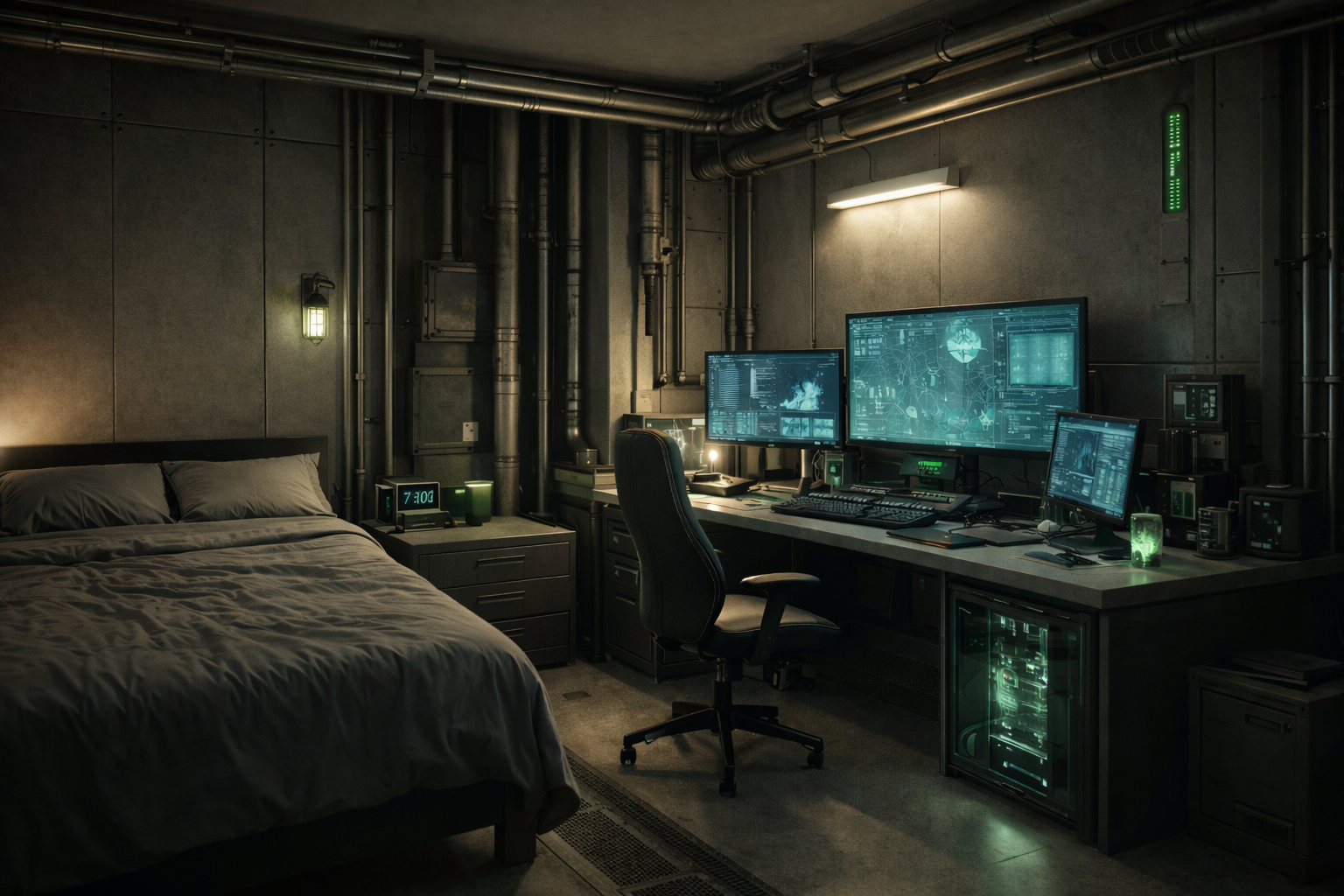
The goal is coherence. When the underlying logic is respected, references and symbols can exist without overwhelming the space. The result feels intentional, grounded, and quietly powerful rather than theatrical.
Why This Aesthetic Endures
Midgar’s design language endures because it is built on systems rather than short lived stylistic fashion. Its environments are defined primarily by how power, energy, and control are organized in space. This makes the city legible even as visual culture evolves.
Instead of relying on fashionable surfaces or decorative technology, Midgar grounds itself in familiar industrial materials and infrastructure. Steel, concrete, glass, exposed machinery, and controlled lighting are not speculative inventions. They already exist in real institutions and cities. The game exaggerates and recombines them, but it does not replace them with purely ornamental futurism. As a result, the city continues to feel contemporary decades after its original conception.
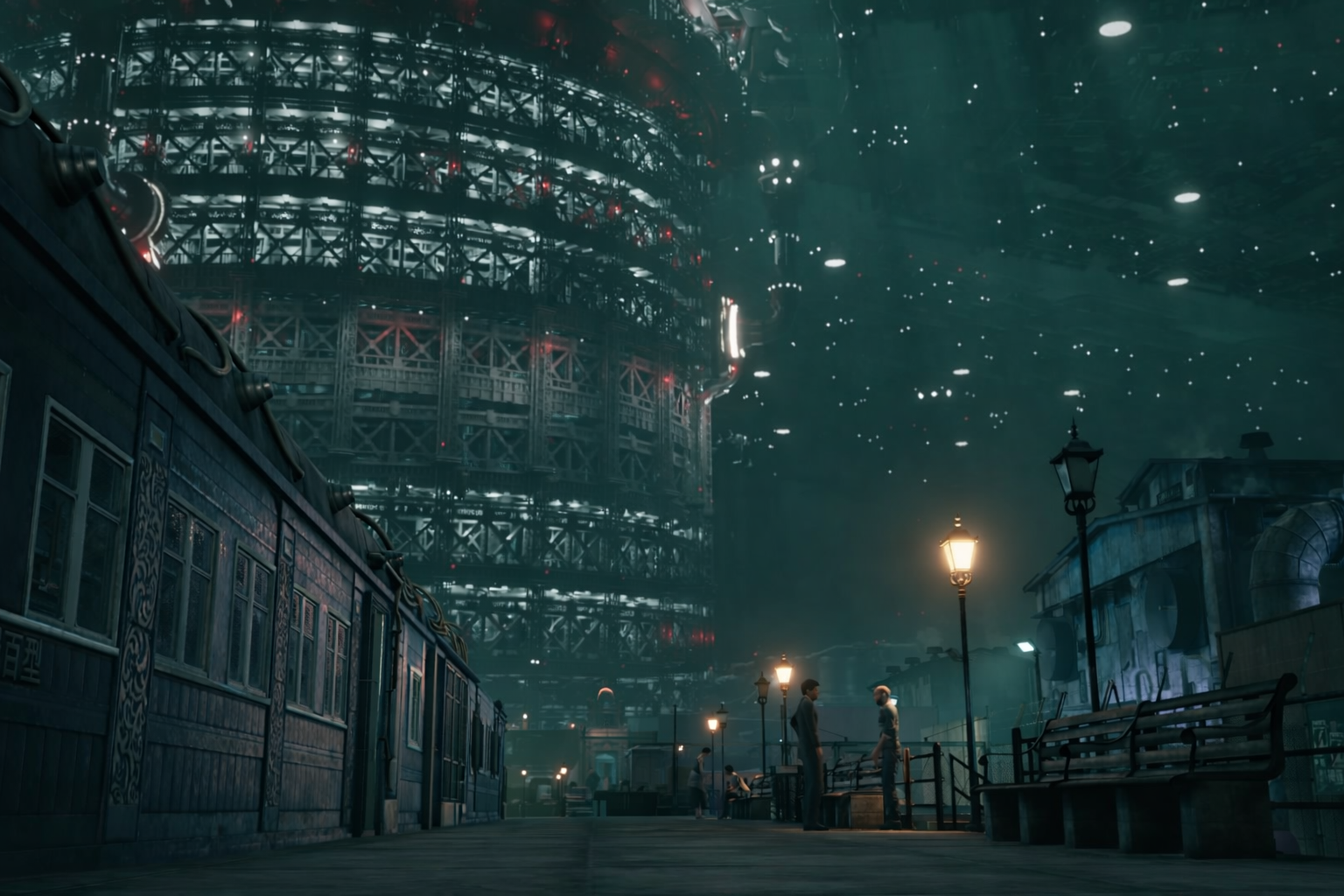
© 1997, 2020 SQUARE ENIX CO., LTD. All Rights Reserved.
Midgar also uses excess deliberately rather than uniformly. Some spaces are restrained in ornamentation, especially those meant to signal institutional authority or efficiency. Others, such as Wall Market or executive areas within Shinra Headquarters, embrace excess and spectacle in different ways. Wall Market concentrates activity and visual density, while Shinra’s executive spaces express power through openness, distance, and monumental scale. This contrast lies in hierarchy. Different spaces are allowed different levels of indulgence based on who they serve and what they are meant to communicate.
What ultimately gives Midgar longevity is coherence. Materials, lighting, scale, and spatial organization reinforce the same power structures across vastly different environments. The city does not decorate the story. It participates in it. Each space teaches the player how the world works before a single line of dialogue is spoken.
For Airship Deluxe, this matters because it shows how strong themed environments avoid novelty traps. When design decisions are grounded in systems and hierarchy rather than surface trends, they remain compelling long after their cultural moment has passed.
Further Reading: Understanding Midgar Beyond the Screen
Midgar’s design works because it rewards sustained observation. Many of its architectural ideas, spatial hierarchies, and material choices are easy to feel during play, but difficult to fully grasp without stepping outside the flow of gameplay. A few books expand on this work by slowing the experience down and examining Final Fantasy VII as a constructed world.
Some publications focus on environmental and production design, offering unobstructed views of Midgar’s districts, interiors, and infrastructure. These references make it easier to study scale, layout, and material language without the distractions of combat or interface elements. Others take a more analytical approach, exploring how Midgar’s architecture, energy systems, and social divisions support the game’s broader themes of power, extraction, and control.

Final Fantasy VII Remake: Material Ultimania
This book offers a behind-the-scenes look at how Midgar’s environments were designed as systems rather than set pieces. Through concept art and developer commentary, it clarifies how scale, materials, lighting, and spatial hierarchy were used to communicate power, control, and imbalance. It’s a strong reference for readers who want to study Midgar’s design logic beyond gameplay.
$25.01
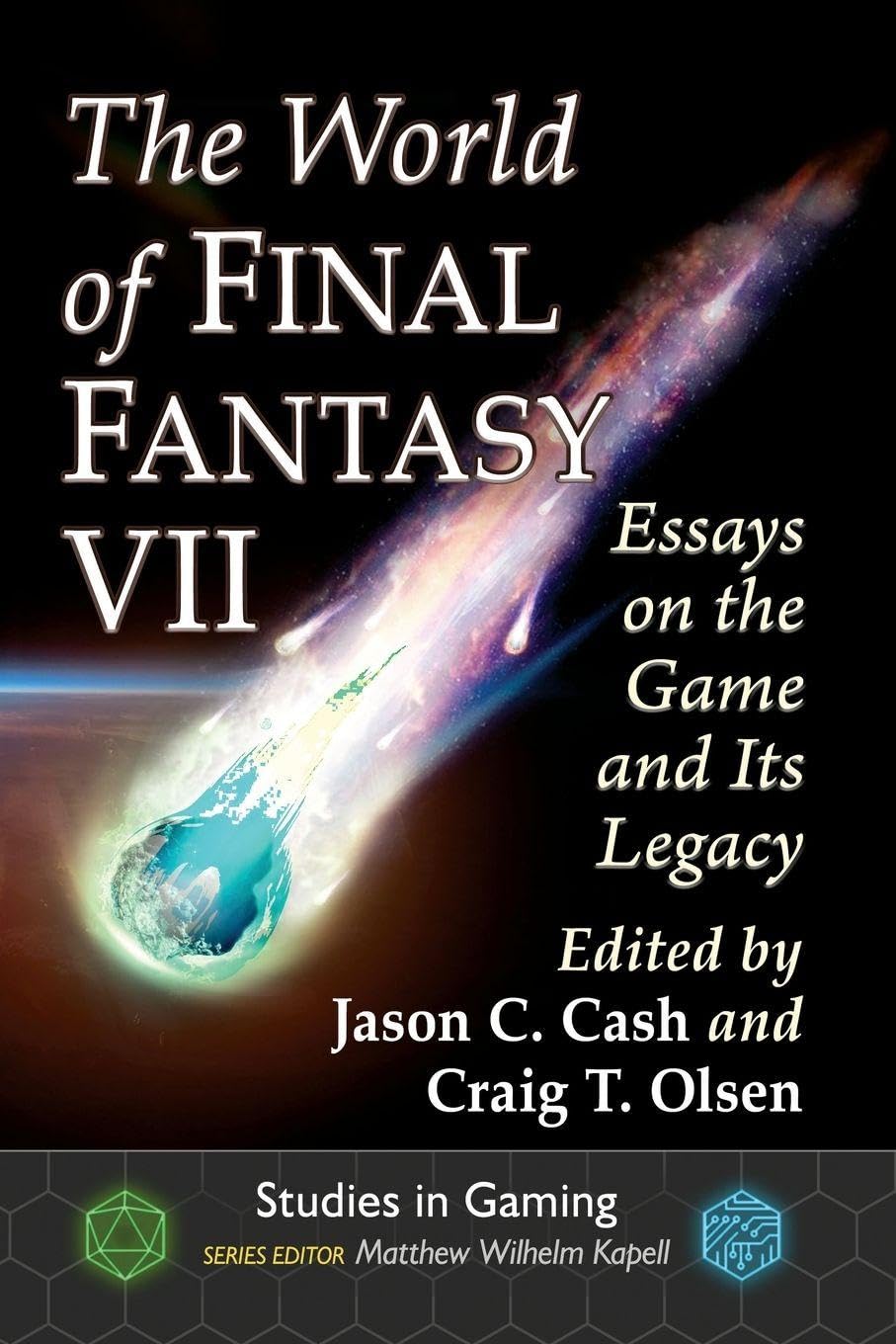
The World of Final Fantasy VII: Essays on the Game and Its Legacy
This collection of essays examines Final Fantasy VII through critical and cultural analysis rather than visual design. Although published before the release of Final Fantasy VII Remake, many of its essays remain relevant, addressing Midgar’s themes of power, energy extraction, environmental cost, and social hierarchy that persist in the modern reinterpretation. It’s best suited for readers interested in interpretation and context rather than production details.
$55
Together, these books extend the ideas discussed in this article. They do not replace the experience of the game, but they do clarify how its environments were conceived, interpreted, and remembered. For readers interested in industrial sci-fi design, environmental storytelling, or the long-term cultural impact of Final Fantasy VII, they provide valuable context and deeper perspective.